


Quick answer: what determines the MOQ and price of custom appliance glass?
Custom appliance glass does not have one standard minimum order quantity or price per square meter. The commercial result depends on part size and yield, glass type and thickness, CNC complexity, edgework, holes, strengthening, printing colors and coverage, coating, inspection level, packaging, annual demand and batch frequency. One-time costs may also include screens, fixtures, gauges, samples and testing.
Buyers receive more comparable quotations when they send a controlled drawing, print artwork, application, quality requirements, destination, forecast and expected order pattern. Ask suppliers to separate one-time development charges from recurring unit cost and to state quotation assumptions. The lowest unit price can be misleading if it excludes sample approval, special inspection, export packaging or normal process loss.
Why “price per piece” is not enough
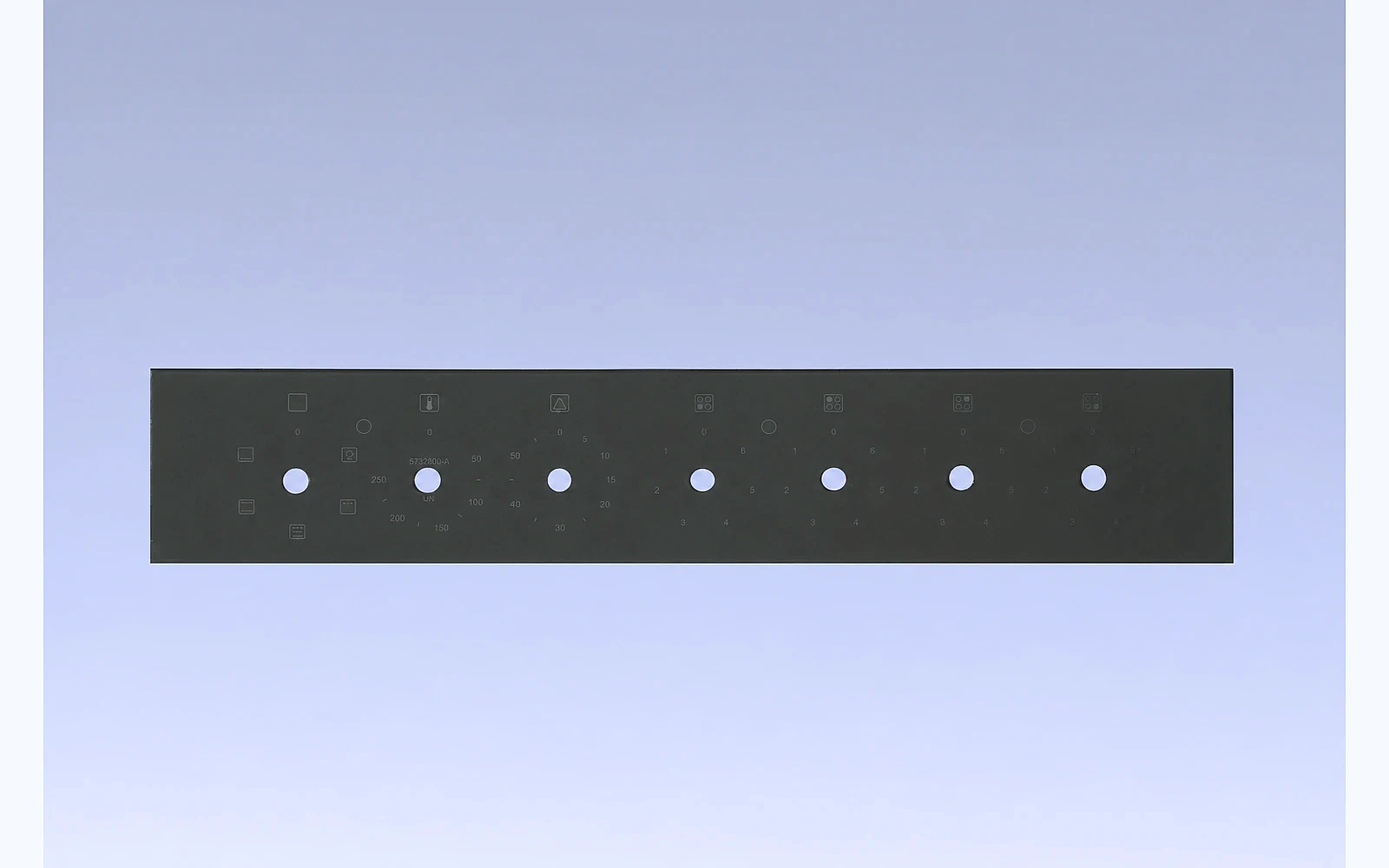
Two black glass panels of similar size can have very different manufacturing routes. One may be a simple rectangle with a single ceramic print. Another may include curved edges, several holes, a dead-front display window, tight registration, multiple colors, a functional coating and special cosmetic inspection. The visible area is similar, but the processing time, tooling, yield risk and validation work are not.
A useful quotation should make the commercial model understandable. It should identify:
- part and document revision;
- included manufacturing processes;
- quoted order quantity and delivery pattern;
- one-time and recurring charges;
- sample status and approval assumptions;
- inspection and test scope;
- packaging and shipment terms;
- validity period and material assumptions;
- exclusions or unresolved technical items.
This does not require disclosing a supplier's confidential cost structure. It requires enough clarity to prevent later surprises.
MOQ is a process question, not only a sales rule
MOQ means minimum order quantity, but different minimums may apply to development, production and replenishment.
Prototype quantity
Prototype quantity is based on how many parts are needed for geometry checks, appearance options, assembly trials, destructive validation and retained references. It can be lower than a production batch, but the unit cost is usually not representative because setup and engineering effort are spread over fewer pieces.
Production batch quantity
The practical production minimum may reflect raw-glass optimization, screen setup, ink preparation, furnace loading, coating runs, inspection labor and packaging configuration. A smaller batch may be technically possible but commercially inefficient.
Commercial order minimum
The supplier may define a minimum order value or quantity that covers planning, purchasing, documentation and shipment preparation. This is separate from the physical process minimum.
Annual volume and call-off pattern
Ten thousand pieces ordered in one stable run are not equivalent to ten thousand pieces divided into many small urgent releases. Forecast visibility, schedule stability and approved stock arrangements influence efficiency and risk.
Buyers should therefore ask, “What drives the proposed MOQ for this part?” rather than treating every MOQ as arbitrary.
The major recurring cost drivers
1. Glass type, thickness and incoming format
Substrate choice affects raw-material cost, availability, cutting layout and process compatibility. Common appliance applications may use different glass compositions or strengthening routes according to thermal, optical, mechanical and regulatory needs. Do not substitute glass types only to reduce price without validating the appliance.
Thickness influences material use, weight, edge processing, hole feasibility, tempering settings, optical stack and packaging. The best thickness is a design decision, not automatically the thinnest or thickest option.
2. Part size and sheet yield
The panel outline must be nested into available stock sheets while accounting for cutting clearances and defects. Large parts, unusual aspect ratios and curved profiles can reduce sheet utilization. A small change in external dimensions may sometimes improve nesting, but any proposal must be reviewed against assembly and appearance requirements.
Ask the supplier whether the quotation assumes a standard stock size, special procurement or customer-supplied material.
3. CNC geometry and edge finishing
Straight rectangles are generally simpler than complex contours with narrow bridges, internal cutouts, notches, multiple holes and mixed edge finishes. Cost can increase through:
- longer machine cycle time;
- additional tool paths or tool changes;
- slower processing around fragile features;
- more inspection points;
- lower yield near tight geometry;
- custom fixtures or gauges.
All cutting, drilling, grinding and edgework must be completed before tempering when using heat-treated flat glass. The current ASTM C1048 listing identifies the active heat-treated flat-glass specification, but buyers must confirm whether that architectural standard is appropriate for their appliance application. The manufacturing principle remains important: late geometry changes can require new glass rather than rework of tempered parts.
4. Strengthening and thermal processing
Tempering involves cleaning, furnace loading, heating and quenching under settings appropriate to the glass and decoration. Small or unusual batches can require dedicated setup and process verification. Part geometry, thickness, printing coverage and required flatness can influence processing risk.
Do not compare an annealed appearance sample with a fully processed production panel as if they carry the same cost and performance.
5. Printing method, colors and coverage
Printing cost is affected by artwork complexity, number of colors, ink system, screen or mask setup, coverage, registration, curing or firing and acceptance limits. Large opaque black areas can require different process control from fine icons or translucent display windows.
Each color may involve a separate screen, preparation and alignment step. Metallic, gradient or highly controlled dead-front appearances can require development trials and physical masters. Our silk-screen versus digital printing guide explains the selection factors.
6. Coating and functional layers
Mirror, conductive, anti-reflective, anti-glare or easy-clean functions add material, process and testing requirements. Coating orientation, exclusion zones, printing sequence and protection during downstream operations matter. A coating should be specified by required function and validation, not by a generic label.
See the functional coatings guide for an OEM selection framework.
7. Optical, touch and bonding interfaces
Display windows may require controlled transmission, haze, color and masking. Capacitive touch interfaces depend on the total glass, print, adhesive and sensor stack. Bonded panels may need surface preparation, tape or adhesive application and fixture control.
Even when the glass supplier does not perform final assembly, tighter interface requirements can add measurement, sampling and process-control cost.
8. Cosmetic and dimensional inspection
Inspection cost depends on the number of characteristics, measurement method, sample rate, reporting, cosmetic zones and acceptance limits. “Zero defects” without defined conditions is not a measurable requirement. A controlled appearance standard may require dedicated lighting, trained inspectors and approved boundary samples.
Overly tight tolerances increase processing and inspection burden. Apply tight limits only where they protect fit, function, safety or customer-visible appearance.
9. Packaging and export logistics
Glass packaging is engineered around panel size, exposed edges, surface finish, quantity, transport mode and unpacking method. Costs may include interleaving, protective film, edge protection, trays, cartons, pallets, moisture protection, labels and pack validation.
Reusable packaging can reduce waste in a stable closed loop, while export shipments usually require practical one-way protection. The export packaging guide explains how to specify and inspect the pack.
One-time development and tooling costs
Not every charge should be hidden in the unit price. Typical one-time items may include:
- engineering and DFM review beyond standard support;
- CNC or inspection fixtures;
- printing screens, plates or masks;
- color matching and trial runs;
- gauges or checking templates;
- coating development;
- prototype and pilot setup;
- customer-specific testing;
- packaging samples or transit trials;
- external laboratory or certification work when required.
Ask whether tooling is customer-owned, supplier-owned or part-specific. Clarify maintenance, storage life, replacement responsibility and transfer rights. A low tooling charge with a high recurring unit cost is not automatically better than the reverse; compare total project economics.
How quantity changes unit cost
Unit cost usually contains variable material and processing plus allocated setup, inspection, scrap risk and overhead. As quantity increases, fixed setup is distributed across more parts. However, the relationship is not perfectly linear.
A volume break may occur when:
- sheet nesting becomes more efficient;
- ink or coating is prepared in an economical batch;
- furnace or production scheduling improves;
- packaging uses full tray, carton or pallet quantities;
- inspection can use an approved sampling plan;
- material can be purchased under a stable forecast.
Conversely, a higher quantity can require more working capital, storage space, packaging and forecast risk. The correct order pattern balances unit economics with demand certainty and revision stability.
What information produces a reliable quotation?
Provide the following before requesting a final commercial comparison:
- part number and drawing revision;
- 2D drawing and, when useful, assembly CAD;
- print artwork and color references;
- glass material, thickness and strengthening requirement;
- coating, optical, touch or bonding requirements;
- cosmetic zones and quality agreement;
- prototype, pilot and validation scope;
- annual volume and order-batch scenarios;
- delivery destination and trade terms;
- packaging, label and traceability requirements;
- target schedule and approval milestones;
- known regulatory or customer-specific requirements.
If some items are open, request a budgetary quotation with explicit assumptions. Do not present a budget estimate as a frozen production price.
How to compare supplier quotations fairly
Create a comparison table that normalizes scope.
| Comparison item | Supplier A | Supplier B | Buyer check |
|---|---|---|---|
| Drawing revision | Same geometry and tolerance basis? | ||
| Process route | Printing, tempering and coating included? | ||
| MOQ and price break | Same batch and annual volume? | ||
| Tooling | Ownership, life and replacement defined? | ||
| Samples | Production-intent or appearance only? | ||
| Inspection | Same characteristics and reports? | ||
| Packaging | Export pack and labels included? | ||
| Delivery terms | Same Incoterm and destination? | ||
| Change control | Revalidation and notification covered? |
The comparison should also consider technical response quality, evidence, lead-time realism and communication. A supplier that identifies an unresolved display-window requirement may be reducing risk, not creating unnecessary complexity.
Cost-reduction methods that protect quality
Freeze requirements early
Late changes can obsolete screens, fixtures, samples, raw material and packed stock. Use a staged prototype-to-production process and release each gate before committing to the next.
Use functional tolerances
Separate critical dimensions from general dimensions. Avoid copying machining tolerances from metal or plastic drawings when they are not needed for glass.
Simplify hidden geometry
Review whether concealed notches, tiny radii, nonfunctional holes or mixed edge finishes add value. Any change must preserve assembly, safety and service needs.
Standardize materials and colors where possible
Using an established substrate, ink system or approved black standard may reduce development work. Standardization should not override optical or appliance requirements.
Plan stable batch releases
Share realistic forecasts and avoid repeated emergency orders. A frame agreement with controlled call-offs can support planning, but only when revision and demand responsibilities are clear.
Approve packaging with the product
Late packaging design can add cost and delay. Pack samples should use representative glass and the intended transport route.
Common quotation mistakes
- requesting price from a photograph without a drawing;
- comparing different materials or strengthening conditions;
- omitting printing coverage or color count;
- assuming a sample price equals production unit price;
- ignoring screens, fixtures, gauges and packaging;
- asking for the lowest MOQ without describing annual demand;
- changing artwork after tooling without budget impact;
- specifying universal zero tolerance or zero cosmetic defects;
- excluding shipment inspection and traceability;
- awarding by unit price before resolving technical assumptions.
Each mistake shifts uncertainty rather than removing cost. The uncertainty usually returns later as a change charge, delay, yield problem or quality dispute.
FAQ
What is the normal MOQ for custom appliance glass?
There is no universal normal MOQ. It depends on geometry, process setup, printing, coating, inspection, packaging and order pattern. Request the process reason behind the supplier's proposed minimum.
Why are prototypes more expensive per piece?
Engineering review, setup, tooling, color trials, inspection and documentation are distributed across a small quantity. Prototype pricing should be separated from expected production pricing.
Can tooling cost be refunded after a volume order?
That is a commercial agreement, not an industry rule. Define the condition in writing, including order value, timing, tooling ownership and any exclusions.
Does more printing always mean a higher price?
Coverage is only one factor. Color count, ink type, registration, opacity, curing, reject risk and inspection may matter more than printed area alone.
How can a buyer reduce MOQ?
Provide a stable forecast, simplify unnecessary complexity, use established materials where suitable and discuss consolidated production or call-off arrangements. The supplier must confirm technical and commercial feasibility.
Should packaging be included in the unit price?
It can be included or shown separately, but the scope must be clear. Define interleaving, film, trays, cartons, pallets, labels and trade terms so quotations are comparable.
Conclusion
Custom appliance glass pricing is the result of a complete manufacturing and quality route, not only glass area. A credible MOQ and quotation connect design, process setup, expected yield, inspection, packaging and delivery pattern. Buyers can improve cost without weakening quality by providing controlled requirements, comparing equivalent scope and stabilizing revisions and schedules.
The most useful quotation is not necessarily the one with the shortest line of numbers. It is the one that clearly states what will be manufactured, approved, inspected, packed and delivered.
Request a transparent custom glass quotation
Tairong manufactures custom oven glass, washing-machine glass, microwave glass, control-panel glass, EV-charger panel glass and coated decorative glass. Send your drawing, artwork, target quantity, annual forecast and destination for a quotation based on defined scope. Final MOQ, price and lead time depend on the approved project requirements.