
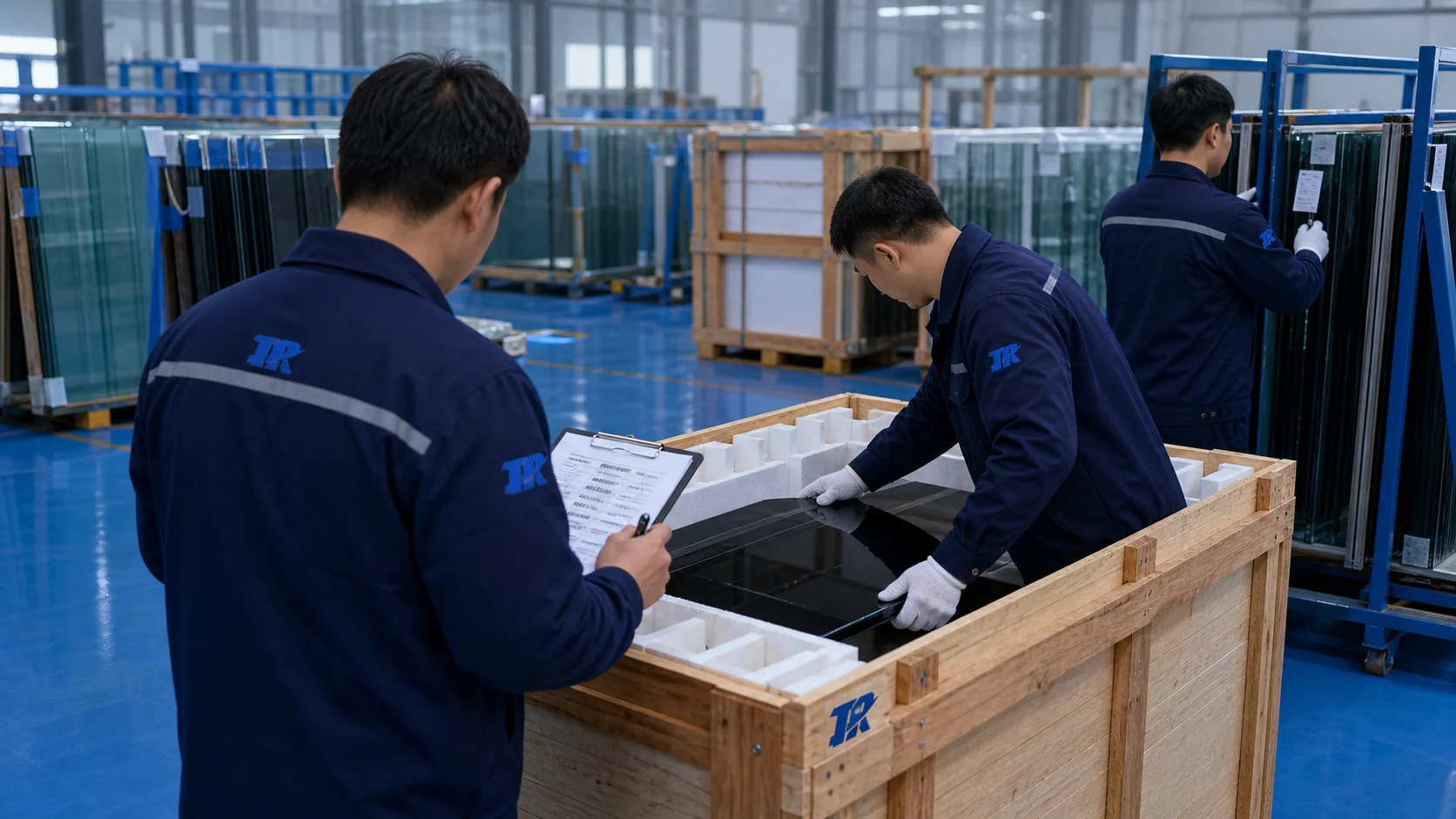
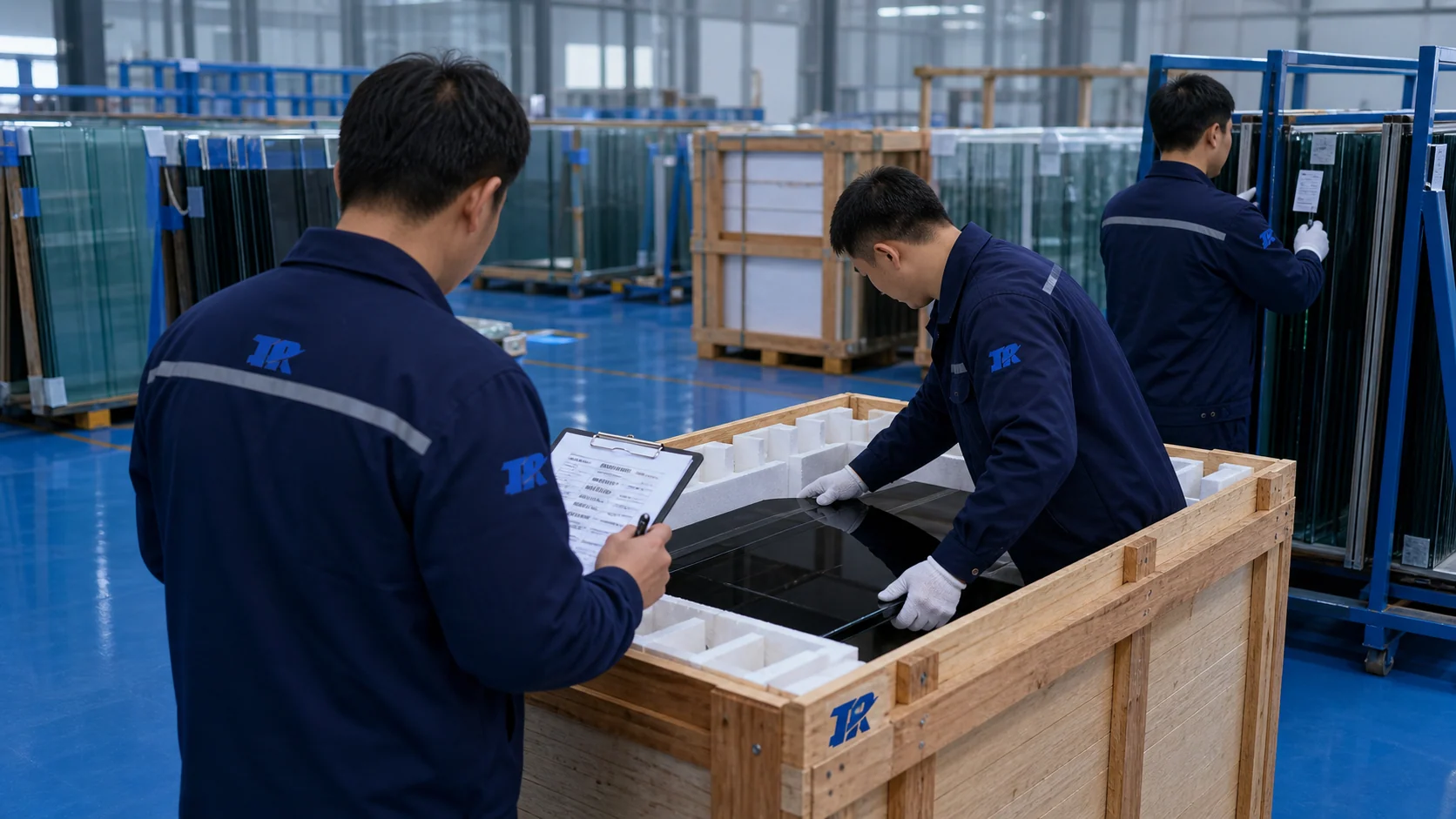



Appliance glass export packaging must protect two vulnerable qualities at the same time: the structural integrity of the glass and the appearance of the customer-facing surface. A panel can arrive unbroken yet still be unusable because of abrasion, coating marks, print transfer, adhesive residue or edge chips.
An effective pack is designed around the actual part, pack quantity, route, handling equipment and customer unpacking process. It should be trialed with production-intent glass and released through shipment inspection. Packaging material alone cannot be called “transit tested” without evaluating the complete packaged product under a relevant procedure.
This guide helps overseas buyers, packaging engineers, quality teams and glass suppliers define a practical route from sample packing to container loading and incoming inspection.
Quick answer: how should custom appliance glass be packed for export?
A robust export plan should:
- Identify the cosmetic face, coating side and fragile edges.
- Prevent glass-to-glass contact.
- Use compatible interleaving or protective film.
- Control part orientation and pack quantity.
- Distribute restraint loads without point pressure.
- Protect edges and corners from impact.
- Keep the pack dry and clean for the planned route.
- Select an inner pack, pallet or crate for the handling system.
- Verify labels, lifting, stacking and unpacking instructions.
- Trial the pack with actual production-intent parts.
- Test the complete packaged product using a route-appropriate method when required.
- Release each shipment against a documented inspection checklist.
The correct design differs for a small parcel, palletized air freight, LCL ocean shipment and a full container. Tell the supplier how the goods will move after they leave the factory.
1. Define what packaging must protect
Start with a risk map for the component.
Structural risks
- Breakage from drop or impact.
- Edge chips from hard contact.
- Cracks from concentrated restraint.
- Damage around holes and cutouts.
- Bending from an unsupported span.
- Pallet or crate distortion.
Cosmetic risks
- Scratches and scuffs.
- Glass-to-glass rub marks.
- Print transfer.
- Coating abrasion.
- Protective-film residue.
- Moisture spots.
- Dust trapped against the surface.
- Marks caused during unpacking.
Identification risks
- Mixed part numbers.
- Wrong drawing or artwork revision.
- Missing batch information.
- Incorrect quantity.
- Labels hidden after palletization.
Classify each panel side and zone. A concealed mounting border may tolerate a different contact method from a glossy user-facing surface or optical display window.
2. Share the transport route before pack design
Packaging should match the distribution system:
- Courier or parcel delivery.
- Air freight.
- Less-than-container-load ocean freight.
- Full-container-load ocean freight.
- Truck to a regional distribution center.
- Multiple transfers through warehouses.
- Direct delivery to an appliance assembly plant.
Document:
- Destination and expected transit time.
- Number of handling stages.
- Pallet or crate restrictions.
- Forklift and pallet-jack access.
- Stacking conditions.
- Warehouse climate.
- Container loading method.
- Customer line-side pack size.
- Returnable-packaging requirements.
A pack optimized for dense container loading may be inconvenient or unsafe at the customer’s assembly line. A good export pack protects the part and supports controlled unpacking.
3. Prevent glass-to-glass contact
Two glass faces should not rub directly during transport. Use an interlayer selected for the surface:
- Paper or tissue.
- Foam sheet.
- Nonwoven separator.
- Corrugated pad.
- Protective film.
- Custom pocket or tray.
The material should be:
- Clean and non-abrasive.
- Chemically compatible with ink and coating.
- Stable under expected humidity and temperature.
- Easy to remove without dragging.
- Free from unacceptable transfer or residue.
Validate protective film
Film can protect a glossy face but introduces questions:
- Adhesive compatibility.
- Peel force after aging.
- Residue after heat or humidity.
- Static attraction of dust.
- Edge lifting.
- Whether the customer can remove it safely.
Approve the exact film and surface combination, not simply “PE film” as a generic category.
Control separator movement
An interleaf that migrates during vibration can expose the glass. Size it correctly or use pockets and restraints that maintain separation.
4. Protect edges and fragile features
Glass edges are sensitive to hard contact and impact. The pack should keep them away from staples, nails, metal straps, pallet boards and rigid protrusions.
Consider:
- Edge channels.
- Corner blocks.
- Foam profiles.
- Suspended dividers.
- Individual sleeves.
- Molded or fabricated inserts.
Features requiring additional attention include holes near edges, deep notches, narrow bridges, exposed polished corners and large display cutouts.
Avoid point loading
Restraints should distribute pressure. A narrow strap, screw head or uneven block can apply concentrated force. Use load-spreading pads and ensure the crate or pallet remains square.
Support the panel consistently
For large or shaped panels, define whether they travel vertically, horizontally or at an angle. The chosen orientation should control bending and prevent panels from sliding into each other.
5. Control pack quantity and weight
More pieces per pack can reduce packaging cost, but it increases:
- Total weight.
- Handling energy.
- Pressure on lower parts.
- Consequence of one pack failure.
- Operator difficulty.
Define:
- Pieces per inner pack.
- Inner packs per outer container.
- Gross and net weight.
- Maximum manual-lift weight.
- Center of gravity.
- Stacking limit.
Use the customer’s line-side consumption and lifting equipment when selecting quantity. A pack should not require operators to tilt or drag glass to remove the first part.
6. Design the crate, carton or pallet as a system
The outer system may include:
- Corrugated carton.
- Reinforced carton.
- Wooden or engineered-material crate.
- Pallet collar.
- A-frame or rack.
- Returnable plastic or metal container.
Selection depends on part size, shipment mode, quantity and destination requirements.
The system should provide:
- Structural support.
- Protection from puncture and clamp pressure.
- Fork access.
- Stack stability.
- Moisture management.
- Suitable closure.
- Clear opening sequence.
Separate glass from wood or hardware
Use a barrier between the panel and rough wood. Confirm that nails, staples and screws cannot protrude into the product space.
Consider export material rules
Wood packaging may be subject to destination requirements such as treatment and marking. The shipper should confirm current import rules for the destination and retain applicable documentation.
7. Manage moisture and container conditions
Ocean and warehouse conditions can include humidity and temperature changes. Moisture may cause:
- Water spots.
- Paper adhesion.
- Label damage.
- Corrosion of mixed hardware.
- Mold on packaging.
- Coating or print appearance changes.
Depending on the route, the pack may use:
- Moisture barrier.
- Desiccant.
- Ventilation.
- Waterproof outer wrapping.
- Container moisture control.
These measures require calculation and validation. Excessive sealing can trap moisture already inside the pack. Pack clean, dry parts and record the packing environment where relevant.
8. Develop packaging with real samples
Do not approve a pack using only a CAD model or a substitute plate. Use production-intent parts with real:
- Dimensions and mass.
- Edge profile.
- Holes and cutouts.
- Printing.
- Coating.
- Protective film.
Perform an unpacking trial with the customer or a representative operator. Check:
- Whether tools can contact the glass.
- Whether the first panel is removable.
- Whether separators stay aligned.
- Whether operators touch the bonding surface.
- How empty packaging is handled.
Document the packing sequence with photos or work instructions.
9. Select a relevant transit test
Transit testing should represent the distribution route and packaged-product system. The International Safe Transit Association explains that its 3-Series procedures are general simulations of transport hazards and lists different procedures for parcel, LTL and other distribution types.
Official references:
ISTA also states that a test applies to the specific packaged product — the complete product and packaging — rather than certifying an individual packaging material.
Match the procedure to the route
For example, ISTA lists:
- Procedure 3A for certain parcel-delivery packaged products.
- Procedure 3B for LTL shipments.
- Procedure 3E for unitized loads moving from manufacturing to a distribution center.
This does not mean one of these automatically applies. Confirm the package weight, distribution type, customer requirement and current procedure with a qualified packaging laboratory.
Define damage criteria before testing
For appliance glass, pass/fail may include:
- No breakage or crack.
- Edge-chip limit.
- No unacceptable scratch.
- No print or coating damage.
- No film residue.
- Pack remains stable.
- Labels remain readable.
Inspect both product and pack after the prescribed test sequence. Record photographs, tested configuration and any deviations.
10. Retest when relevant variables change
ISTA advises retesting when a change in product, package or process could affect performance. For appliance glass, review retest need after changes to:
- Panel size, shape, thickness or mass.
- Hole or cutout geometry.
- Surface coating or film.
- Pieces per pack.
- Separator or foam material.
- Carton, crate or pallet.
- Supplier or packing location.
- Shipment mode or route.
Reference: ISTA: When should a packaged product be retested?.
Use a controlled packaging specification with material codes and revision history.
11. Create a shipment inspection checklist
Shipment inspection should verify the product and the pack.
Product identity
- Customer and purchase order.
- Part number.
- Drawing and artwork revision.
- Quantity.
- Batch or lot.
Product inspection status
- Required dimensional checks completed.
- Appearance inspection completed.
- Print, optical or coating checks completed.
- Nonconformance disposition closed.
- Required reports attached.
Packaging
- Correct separator and film.
- Correct orientation.
- Pieces per pack.
- Edge and corner protection.
- Inner and outer closure.
- Moisture protection.
- Gross weight and dimensions.
- Pallet or crate condition.
Labels and documents
- Product and batch labels.
- Handling symbols.
- Stack limit.
- Gross/net weight.
- Country-of-origin and destination documents where required.
- Packing list.
- Photos of closed packs and loading.
Shipment inspection does not replace process control. It confirms that the released goods and packaging match the approved specification.
12. Protect the goods during container loading
At loading, verify:
- Container or vehicle is dry, clean and undamaged.
- Heavy goods cannot fall onto the glass.
- Pallets or crates are restrained against movement.
- Forklift contact points are clear.
- Stack limits are respected.
- Door closure will not contact the load.
- Labels remain accessible.
Photograph the empty container, loading sequence, restraint and final door condition where appropriate. Record seal information according to the shipping process.
For mixed loads, isolate the glass from metal parts, liquids or sharp cargo. Consider how the load will be unloaded at destination.
13. Plan incoming inspection and feedback
Ask the customer to record:
- External pack condition.
- Moisture or impact evidence.
- Position of damaged pieces.
- Type and location of damage.
- Pack and batch identification.
- Photos before and during unpacking.
This information helps distinguish production defects, pack design issues and handling events.
Monitor early shipments closely. Laboratory testing and historical experience are valuable, but actual route feedback confirms how the pack performs in the intended supply chain.
Export-packaging RFQ checklist
When requesting a quotation, provide:
- Part drawing and photo.
- Cosmetic face and coating orientation.
- Glass dimensions, thickness and mass.
- Fragile holes, cutouts and corners.
- Pieces per delivery and annual estimate.
- Preferred line-side pack quantity.
- Destination and shipment method.
- Pallet, crate and material restrictions.
- Required transit test.
- Label and document requirements.
- Returnable or disposable preference.
Ask the supplier for a pack proposal, materials list, packing work instruction, trial plan, inspection checklist and change-control method.
FAQ
Is protective film always required on appliance glass?
No. Film is useful for some glossy or coated surfaces, but compatibility, residue, aging and removal must be evaluated. A clean separator or individual pocket may be better for another panel.
Should glass panels be packed vertically or horizontally?
The correct orientation depends on size, shape, support, quantity and handling. Validate the proposed orientation with real parts and the complete pack.
Can a packaging material be described as ISTA certified?
ISTA procedures evaluate a specific packaged-product system, not an individual material by itself. Any certification or test claim should identify the tested product, pack configuration and procedure.
What should shipment inspection include?
Confirm part and revision, quantity, required product-inspection status, separator, film, orientation, edge protection, closure, labels, pack condition and loading documentation.
When should packaging be retested?
Review retest need after changes to the product, pack, packing process or distribution route. Changes in size, mass, coating, pieces per pack or material can affect performance.
How can a buyer investigate transit breakage?
Preserve the pack, record photos before unpacking, identify the damaged position, batch and pack, and compare the evidence with loading photos and the approved pack specification.
Conclusion
Export packaging is part of appliance-glass quality. It must protect breakage-sensitive edges and appearance-sensitive surfaces through factory handling, international transport and customer unpacking.
Build the pack from a documented risk assessment, trial it with production-intent parts, use a route-appropriate packaged-product test where required, and release shipments with traceable inspection. Then use actual delivery feedback to improve the controlled packaging specification.
CTA: Request an appliance glass packaging review
Send Tairong your glass drawing, surface and coating information, shipment quantity, destination, transport mode and line-side requirements. We can review the component and packaging information needed for sampling and quotation.
Primary CTA: Ask for a Packaging Proposal
Related products: Custom appliance glass products
Related guide: How to evaluate appliance glass manufacturer quality control