
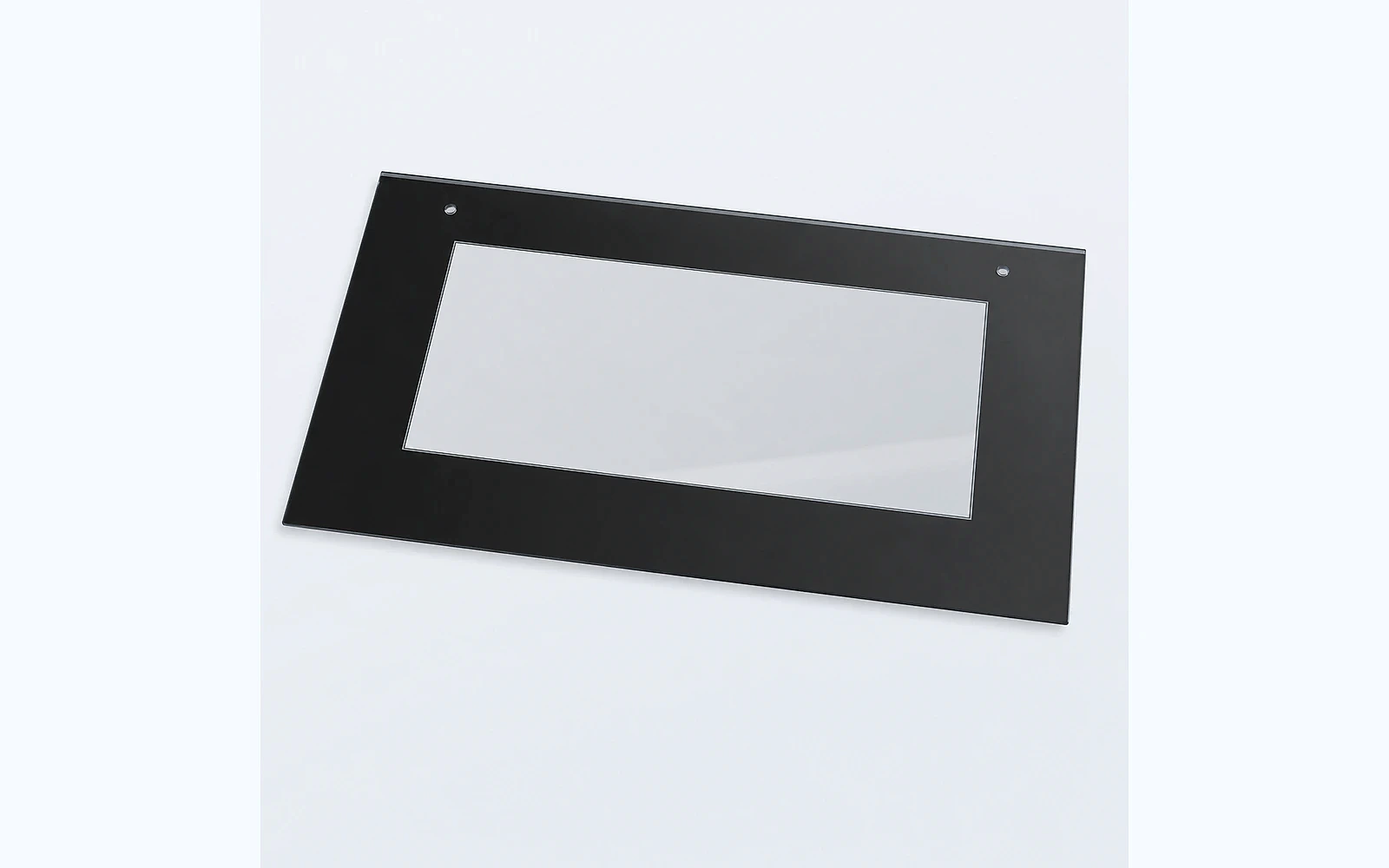




Tempered oven door glass is not a standard sheet selected only by width, height and thickness. It is an engineered appliance component whose performance depends on its position in the door, edge condition, cut-outs, printed areas, coating, mounting method and the temperature profile of the complete oven.
This distinction matters during sourcing. A drawing may describe a black rectangular panel, but it may not explain whether the part is an external decorative fascia, an intermediate heat-management layer or an inner panel exposed to the cavity environment. Those positions do not automatically require the same material, printing system or validation plan.
A reliable quotation therefore begins with the appliance architecture. The glass manufacturer needs to understand what the panel does, how it is supported and what the appliance-level tests must demonstrate. This guide gives OEM engineers, purchasing teams and product managers a practical framework for preparing that specification.
Quick answer: what should an oven door glass specification include?
An effective tempered oven door glass specification should define:
- The panel position and function within the oven door assembly.
- The base glass, nominal thickness and required strengthening condition.
- Overall geometry, datums, tolerances, holes, slots and corner radii.
- Edge finish and any exposed cosmetic zones.
- Printed borders, icons, display windows and approved color references.
- Decorative, conductive or other coating requirements.
- Mounting points, gaskets, adhesive, clips and allowable assembly loads.
- Thermal, mechanical, chemical and cosmetic validation requirements.
- Inspection conditions, traceability and approved limit samples.
- Prototype, pilot, packaging and shipment-release requirements.
The approved drawing and validation plan should control production. A photograph or an old physical sample can support the review, but it should not replace measurable requirements.
1. Identify the glass position in the oven door
An oven door may use more than one glass layer. Begin by naming the position and function of the part.
External decorative door glass
The external panel contributes strongly to appliance appearance. It may include:
- A black or colored printed border.
- A viewing window.
- A brand area or product markings.
- Holes or slots for handles and mounting hardware.
- A shaped edge or curved profile.
- A coating that changes reflectivity or visual density.
For this panel, appearance, cleanability and assembly fit are often as important as the thermal requirement.
Intermediate glass
Intermediate layers can form part of the door's thermal-management structure. Their spacing, support and ventilation belong to the complete appliance design. The glass supplier should not assume the operating temperature from the words "oven door" alone.
Inner door glass
The inner panel is closer to the cavity and may experience more demanding thermal conditions, cleaning exposure and contact with door hardware. The appliance manufacturer must define the expected temperature profile and applicable safety tests.
State clearly whether the part is external, intermediate or internal. Include a door cross-section when possible. This allows the supplier to review the correct risks rather than applying a generic recommendation.
2. Select material and strengthening around the application
"Tempered glass" describes a process condition, not a complete material specification. The drawing should identify the base material, thickness and required strengthening state.
Common project discussions may involve:
- Clear soda-lime glass for printed decorative panels.
- Low-iron glass where color neutrality through the substrate is important.
- Tinted glass when the substrate contributes to the powered-off appearance.
- Another heat-resistant material where the appliance design and validation standard require it.
Avoid choosing a material only from a generic maximum-temperature number. Finished performance is influenced by thickness, edge quality, holes, surface treatment, mounting stress, heating rate and temperature difference across the panel.
The National Glass Association specification for fully tempered appliance glass is a useful engineering reference. It also reinforces a critical manufacturing rule: cutting, drilling and edge processing must be completed before full tempering. The appliance brand still needs to determine which product safety standards apply in each destination market.
Do not confuse material qualification with appliance qualification
A material certificate cannot prove that the complete oven door is safe. The final assembly includes glass spacing, metal frames, gaskets, fasteners, adhesives and ventilation. Validate the glass in the intended assembly or a representative fixture.
3. Freeze geometry before tempering
The drawing must control all fabrication features before tempering:
- Overall length and width.
- Nominal thickness.
- Corner radii.
- Handle and mounting holes.
- Slots, notches and display openings.
- Printed-area boundaries.
- Edge profile.
- Datums for critical feature positions.
Use dimensions from common datums when holes or windows must align with a housing. A long chain of dimensions can accumulate variation and make the final assembly difficult even when each individual dimension appears acceptable.
Review fragile geometry early
Narrow webs between a hole and an edge, sharp internal corners and closely spaced cut-outs can increase processing risk. Instead of finalizing these features in isolation, ask the glass fabricator to review them during design for manufacturability.
A useful DFM response should identify:
- Features requiring more clearance.
- Radii that are difficult to process repeatably.
- Tolerances that conflict after edge grinding.
- Areas needing dedicated inspection fixtures.
- Cosmetic zones likely to show process marks.
Changes are less expensive before sample tooling and printing screens are released.
4. Specify edges, holes and mounting interfaces
Edge condition is part of both product safety and appearance. Distinguish between:
- Exposed customer-facing edges.
- Assembly-handling edges.
- Edges hidden by a frame.
- Local areas near clips, screws or handle hardware.
The drawing may call for seaming, grinding, flat polishing, beveling or a rounded profile depending on the design. Define cosmetic acceptance separately for visible and hidden zones.
For holes and fasteners, show the complete interface. Glass should not be exposed to uncontrolled point loading from a metal screw or sharp bracket. The appliance assembly may require a bushing, washer, gasket, controlled torque or compliant support.
During installation preparation, check that:
- The metal or plastic support is flat and free of burrs.
- Gasket thickness is controlled.
- Adhesive beads do not create hard local contact.
- Fasteners cannot move into direct contact with the glass.
- Assembly tools cannot strike an exposed edge.
- The panel is not forced into a distorted frame.
Many field failures are system problems rather than a simple material-selection problem.
5. Treat printing as a functional layer
Oven door glass printing can perform several jobs:
- Masking the metal frame and insulation.
- Defining the viewing area.
- Creating a uniform powered-off appearance.
- Carrying icons, scales or control markings.
- Supporting brand color and decorative design.
Provide vector artwork and identify the controlled revision. State whether the print is viewed through the glass or printed on the user-facing surface.
The print specification should address:
- Number and sequence of colors.
- Color reference or approved physical master.
- Required opacity.
- Gloss or matte appearance.
- Registration to holes, edges and viewing windows.
- Pinholes, contamination and edge-bleed limits.
- Inspection lighting, background and viewing distance.
- Heat and chemical durability required by the appliance validation plan.
A black border is not automatically one universal black. Substrate tint, ink thickness, backing material and lighting all change visual perception. Approve the color through the final glass stack under controlled conditions.
6. Define coatings by measurable function
Some oven glass projects require a functional or decorative coating. The RFQ should describe the result rather than using an ambiguous coating name.
Possible objectives include:
- Adjusted reflectivity.
- Controlled light transmission.
- A mirror or hidden-display appearance.
- Electrical conductivity.
- Easier cleaning or reduced fingerprint visibility.
- Decorative color density.
For each coating, identify the coated surface and any areas that must remain uncoated. Define how the result will be inspected and what durability test applies.
If a conductive coating is considered, include the electrical target, measurement points, busbar or contact concept and the way the coating interacts with printed layers. The final electrical and thermal function must be validated in the appliance system.
7. Build a realistic thermal validation plan
Do not ask the glass supplier to guarantee an undefined oven temperature. Provide the expected operating and test conditions.
Useful information includes:
- Normal operating temperature range at the glass location.
- Maximum abnormal-condition exposure.
- Heating and cooling rate.
- Temperature difference across the panel.
- Distance from heating elements.
- Door-opening cycle.
- Cleaning cycle and contact with liquids.
- Temperature measurement method and sensor location.
The validation plan may include thermal cycling, thermal-shock evaluation, mechanical loading and appliance-level abnormal-operation tests. The exact plan depends on the oven design and target-market requirements.
Record the assembly used for testing
A bare panel on a laboratory support does not reproduce the stress state of a bonded or clipped oven door. Record:
- Frame revision.
- Gasket or adhesive.
- Fastener torque.
- Glass orientation.
- Spacing between layers.
- Test fixture and loading.
This makes results traceable when the door design changes.
8. Control cosmetic and dimensional inspection
An oven door is a large visible surface, so undefined cosmetic language creates disputes. Replace "no defects" with an agreed method.
Define:
- Inspection lighting.
- Background color.
- Viewing distance and angle.
- Inspection time.
- Critical viewing window and border zones.
- Acceptable scratch, inclusion, pinhole and print-defect limits.
- Whether the part is inspected before or after protective film.
Dimensional inspection should focus on critical-to-function characteristics such as mounting holes, handle interfaces, viewing-window position and assembly datums.
For printed or coated glass, factory testing can include:
- Print registration.
- Color comparison.
- Opacity or transmission.
- Coating appearance.
- Adhesion or durability according to the agreed method.
- Backlit inspection where applicable.
The inspection report should identify the part number, drawing revision, batch and measurement method.
9. Approve samples in controlled stages
Trying to approve geometry, color, thermal performance and packaging with one early sample creates avoidable confusion.
Engineering sample
Use the first sample to confirm basic dimensions, holes, edgework, assembly fit and process feasibility.
Appearance sample
Confirm final print color, opacity, viewing window, coating and powered-off appearance. Use a documented physical master or limit sample.
Functional validation sample
Install the glass in the representative door assembly and complete the required thermal, mechanical and cleaning tests.
Pilot production
Use production-intent tooling, fixtures, inspection methods and packaging. Review repeatability before mass-production release.
Any approved change should update the drawing, artwork and sample reference together. Do not allow an email instruction to become an uncontrolled permanent specification.
10. Plan export packaging before production release
Large oven panels can be vulnerable to edge impact, surface abrasion and load concentration during transport.
The packaging specification should define:
- Interleaving material.
- Protective film.
- Orientation inside the carton or crate.
- Edge protection.
- Quantity per pack.
- Pallet and moisture protection.
- Maximum pack weight.
- Part, batch and revision labels.
Shipment inspection should verify the correct revision, quantity, cosmetic status, labels and packaging condition. Photographs are useful supporting evidence, but they do not replace a documented inspection result.
OEM oven door glass RFQ checklist
Before requesting a quotation, send:
- Controlled 2D drawing and optional 3D assembly reference.
- Door cross-section showing the panel position.
- Material and thickness requirement.
- Print artwork and color reference.
- Coating function and target.
- Mounting and handle details.
- Operating and validation conditions.
- Prototype and annual volume.
- Destination and packaging requirement.
- Required inspection documents.
Ask the supplier to return its material proposal, manufacturing route, DFM comments, open questions, sample plan, inspection assumptions and quotation basis.
FAQ
Is every oven door glass panel made from the same type of tempered glass?
No. External, intermediate and inner panels perform different functions. The material, thickness, printing, coating and validation route should be selected around the specific door position and appliance design.
Can holes be drilled after tempering?
Fabrication features should be completed before full tempering. Hole position and geometry therefore need to be finalized and reviewed before the tempering process.
How should black printed borders be approved?
Use controlled artwork, a color reference or physical master, and defined inspection lighting. Evaluate the color through the final glass and with the actual backing or assembly where appearance is critical.
What information helps a supplier evaluate thermal risk?
Provide the glass position, measured temperature profile, heating and cooling rate, temperature differential, door construction, mounting method and applicable appliance-level tests.
Should packaging be discussed before mass production?
Yes. Packaging affects delivered quality, line-side handling and cost. Approve it during pilot production using the intended shipping route and pack quantity.
Conclusion
A dependable oven door glass program begins with the door system, not a generic request for black tempered glass.
Define the panel position, geometry, edges, print, coating, mounting and validation conditions. Review fragile features before tempering. Approve appearance and function through controlled samples, then confirm repeatability and packaging in a pilot run.
This process gives purchasing teams a more comparable quotation and gives engineering teams a clearer route from drawing to stable production.
CTA: Request an oven glass manufacturing review
Planning a new oven door, viewing window or control fascia? Send Tairong your drawing, door cross-section, print artwork, application conditions and target volume. Our team can identify the information needed for sampling and quotation.
Primary CTA: Send Your Requirements
Related products: Custom oven glass solutions