




Quick answer: durability must be defined as a use condition and a test method
Durable screen-printed appliance glass is not created by naming a color or asking for “permanent printing.” The OEM must define where the ink is printed, how it is fired or cured, which side faces the user, the operating temperature, cleaning agents, abrasion exposure, edge and hole geometry, acceptable color variation, and the pass/fail method. The supplier then selects a compatible glass–ink–process combination and validates it on production-intent parts.
For many thermally toughened soda-lime components, a ceramic enamel is printed before tempering and fused to the glass during the heating cycle. Other glass materials, low-temperature substrates, conductive features or special optical windows may require a different ink system. The correct route depends on the product application and customer requirements, not on a universal recipe.
Why decorative printing is a functional engineering feature
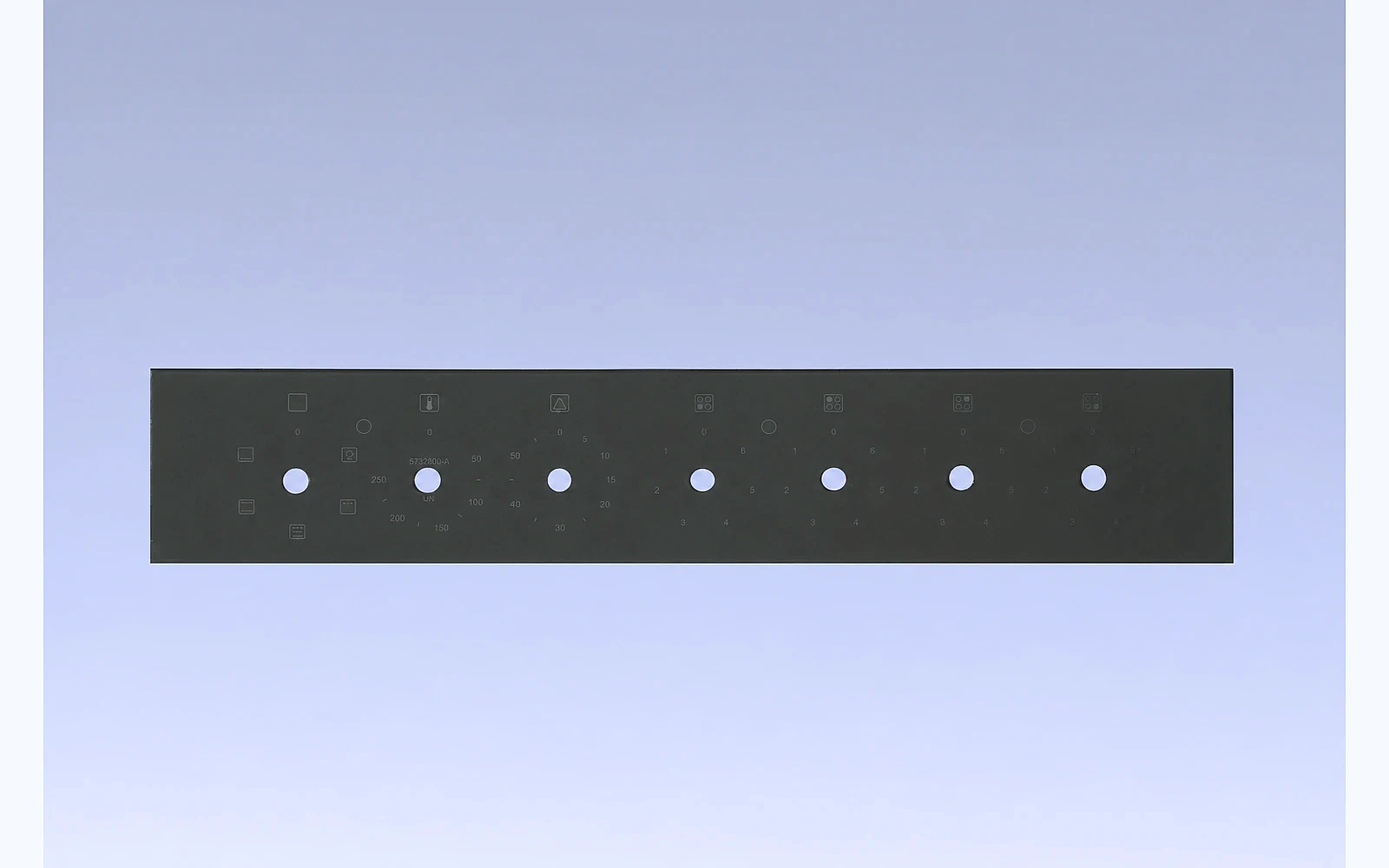
Printing on appliance glass does more than add a logo. It may create an opaque border that hides adhesive, a dead-front area that reveals a display only when illuminated, legends that guide the user, a patterned viewing window, a conductive or capacitive interface, or a visual alignment reference for assembly. A cosmetic defect can therefore become a usability, bonding, optical or production problem.
The decoration also experiences stresses that a flat color sample does not represent. It can be heated, cooled, wiped, sprayed with kitchen or laundry chemicals, touched with oily fingers, exposed to ultraviolet light, bonded to a frame, bent by assembly loads and packed for export shipment. Ink performance must be considered together with glass forming, edge finishing, tempering, coating, bonding and installation preparation.
Start with the print location and functional layers
Surface one, two, three or four is not a sufficient instruction by itself
An engineering drawing should identify the printed face using a view and section that cannot be misread after the part is flipped. State which face is exposed after assembly and which face is bonded, enclosed or accessible to cleaning. For a curved or asymmetric part, include orientation marks that are removed or hidden in the final product.
Printing on the protected rear face can reduce direct abrasion, but it may change the perceived color because the viewer sees the ink through the glass. Glass tint, thickness, coating and lighting then influence the final appearance. Printing on an exposed face may produce a more direct color but usually requires more attention to wear and chemical resistance. The decision should follow the finished assembly, not the appearance of an isolated sample.
Separate decorative, masking, optical and electrical functions
The drawing should distinguish:
- opaque borders and adhesive masks;
- symbols, text and control legends;
- display windows with controlled transmission;
- halftone or dot patterns used around viewing areas;
- conductive or sensor-related features, when applicable;
- registration features required by downstream assembly.
Each feature may need a different acceptance criterion. A small pinhole in an adhesive mask may be unacceptable because light leaks through it, while the same-sized feature in a non-illuminated decorative area may be evaluated differently. A display window needs optical limits; a user legend needs legibility and registration; a hidden border may prioritize opacity and bond compatibility.
Select an ink system that fits the glass and thermal process
Ceramic enamel for tempered flat glass
Ceramic enamel commonly contains glass frit and pigment. It is applied to the glass and fired so the enamel bonds to the surface. In many flat-glass applications, firing occurs during the tempering cycle. Pilkington describes screen-printed glass as having ceramic ink fired onto the glass surface during toughening. This is a useful process principle, but it does not mean every enamel, color and glass thickness can share one furnace profile.
Firing that is too low may leave insufficient maturity or weak appearance. Excessive heat or time can affect color, gloss, opacity, surface quality or glass shape. Dark, high-coverage prints may absorb heat differently from clear zones, increasing the importance of recipe control and part orientation. The ink supplier’s technical guidance, the glass processor’s validated window and the OEM’s performance tests must agree.
Organic and specialty inks
Organic inks may be used where firing temperatures are unsuitable, where a particular visual or functional effect is required, or where another substrate or coating system is involved. Their cure mechanism, adhesion and resistance to heat, chemicals and light differ from fired ceramic enamel. A purchase order should therefore identify the approved system or required performance, rather than treating all printed glass as equivalent.
Specialty layers—metallic appearances, conductive inks, low-emissivity or reflective coatings, anti-fingerprint treatments and optical filters—can interact with decoration. Layer order and masking boundaries should be defined before sampling. If a layer is changed, the relevant qualification tests should be repeated.
Convert the appearance target into measurable requirements
Use a controlled master, not a phone photograph
Color approval should be based on an agreed physical master, a defined color value under stated measurement conditions, or both. Record the illuminant, observer, instrument geometry, background, measurement side and whether the reading is through the glass. Digital screens and photographs are useful for discussion but are not stable production standards.
For visual comparison, specify lighting, viewing distance, viewing angle and background. Dark ink on clear glass can look different on a white inspection table, a black appliance cavity and an illuminated display assembly. The approval environment should represent the product function.
Define opacity, gloss and texture where they matter
Opacity is particularly important above light sources, adhesives and internal components. State whether the criterion is visual, transmission-based or instrument-based. If a customer requires a maximum transmission level, also define the wavelength range, aperture and measurement location.
Gloss and texture affect premium appearance and fingerprint visibility. They also influence how a scratch or printing variation is perceived. If gloss is a key characteristic, define the measurement method and zones rather than using “matte” or “high gloss” alone.
Registration and feature geometry
Printed symbols, display windows and touch keys must align with glass edges, holes and the assembled electronics. The drawing should establish datums, dimensions and tolerances from functional references. A general note such as “printing centered” is not adequate when a display module has a narrow border or a touch electrode needs consistent overlap.
Include minimum line width, minimum gap, text size, dot pattern and inspection magnification only where necessary. Extremely fine features may need a different printing method or a design adjustment. Early DFM review helps the supplier identify mesh, ink deposit and registration risks before tooling.
Build a durability test matrix from the real environment
There is no single test that proves print durability for every appliance. A meaningful matrix connects each risk to an exposure, sample condition and acceptance rule.
| Product risk | Possible evaluation | Conditions that must be stated | Typical acceptance focus |
|---|---|---|---|
| User wiping | Controlled rub or abrasion test | pad/material, load, strokes, speed, dry or wet | no unacceptable wear, color loss or exposed glass |
| Detergent or cleaner | Spot, wipe, immersion or repeated cycle | chemical name/concentration, temperature, dwell, rinse | no blistering, softening, staining or loss of adhesion |
| Heat exposure | thermal aging or operating cycle | peak temperature, ramp, dwell, number of cycles | no cracking, discoloration, delamination or functional change |
| Humidity | damp heat or condensation cycle | temperature, relative humidity, duration, recovery | appearance and adhesion remain within specification |
| Bonding | adhesive compatibility evaluation | adhesive, primer, cure, bond width and aging | no ink lift, interface failure or visible reaction |
| Light exposure | defined UV or light-aging method | source, irradiance, duration, temperature | color change within approved limit |
| Shipment handling | packaging simulation and inspection | pack design, orientation, vibration/impact program | no rubbing marks, transfer or cosmetic damage |
These examples are planning categories, not universal test values. The OEM must choose methods and severity that match the appliance, market and regulatory obligations. A test report without the chemical identity, load, cycles and acceptance criteria cannot be compared reliably.
Five tests buyers frequently misunderstand
1. Adhesion
“Good adhesion” must identify the method, sample conditioning and evaluation. Tape selection, cut pattern, tool condition, dwell, pull angle and aging can change the result. A test on a flat printed coupon may help screen materials, but the final qualification should include production-intent parts because firing, edge proximity and local geometry can influence performance.
2. Abrasion and rub resistance
A rub test should represent the contact mechanism. A dry cloth, abrasive pad, eraser, brush and detergent-soaked fabric generate different damage. Specify the counter-material, force, path, cycle count and whether the same area is repeatedly contacted. Inspect both appearance and function: a legend may remain visible but become glossy, or an opaque mask may develop light leaks.
3. Chemical resistance
“Household cleaner resistant” is too broad. List the exact customer-approved chemicals or chemical families, concentration, exposure temperature and cleaning sequence. Kitchen degreasers, alkaline detergents, acids, alcohols and disinfectants can behave differently. Include recovery time before inspection because temporary staining or swelling may change after drying.
4. Thermal cycling
Thermal cycling should reproduce the relevant gradients, not just an oven air temperature. A printed border beside a clear window can heat unevenly. The complete assembly may constrain the glass or shield part of it. Instrumented prototype testing can reveal where thermocouples should be placed and whether the laboratory cycle represents actual use.
5. Color consistency after firing
Color can shift with ink batch, deposit thickness, glass tint and furnace history. Approve a range rather than one perfect sample, then monitor the inputs that influence it. If a part contains multiple colors, define whether overprint order and registration are critical. Color assessment should occur after the complete production process, not only after printing.
Validate decoration at three stages
Stage 1: material and process feasibility
Use early samples to confirm ink compatibility, achievable color, opacity, line definition, registration and firing behavior. Review the drawing for edge distances, holes, coating boundaries and bend or curvature requirements. These samples can expose design risks but should not be mistaken for production approval.
Stage 2: production-intent qualification
Produce samples with intended glass, thickness, edge work, printing equipment, ink, furnace route and inspection method. Record batch identities and key process settings in the supplier’s controlled documentation. Conduct appearance, dimensional, optical and durability tests required by the customer.
Where decoration contacts adhesive, foam, gasket or plastic, test the real interface after the intended cure and aging. Installation preparation—cleaning, surface activation, primer application and fixture pressure—can be as important as the printed layer.
Stage 3: mass-production control
An approved sample does not replace ongoing control. The control plan should identify incoming ink checks, storage and mixing conditions, mesh or stencil control, print registration, wet-film or deposit indicators where applicable, furnace recipe, visual inspection, color or opacity checks and reaction rules.
Shipment inspection should confirm the approved appearance, part identity, packaging protection and quantity. Retained samples and traceable lot records help distinguish a printing issue from transport rub, assembly contamination or later chemical exposure.
Supplier questions that reveal process readiness
Ask the potential glass processor:
- Which ink family and firing or curing route is proposed for this glass?
- Which print face will be used, and how will orientation be controlled?
- How are ink storage, mixing, viscosity and usable life managed?
- How are mesh condition, deposit consistency and registration checked?
- How is the furnace recipe linked to glass thickness, print coverage and color?
- What visual standards and measurement equipment are available?
- Can the supplier test customer cleaning chemicals, or must an external laboratory be used?
- How are nonconforming parts segregated and process changes approved?
- How are samples and batches traced through printing, tempering and packing?
- Which tests are routine production checks and which are qualification-only?
The strongest answer is a process explanation supported by records and sample evidence, not a broad claim that the ink “never comes off.”
Procurement checklist for an RFQ
Include the following with the drawing and forecast:
- glass material, thickness and tempering requirement;
- print face and finished assembly orientation;
- artwork in a controlled vector format;
- color master or color values with measurement conditions;
- opacity, transmission, gloss or texture limits where functional;
- registration datums and tolerances;
- approved cleaning chemicals and exposure sequence;
- abrasion, adhesion, heat, humidity, light and bonding tests where relevant;
- cosmetic inspection zones, lighting and defect limits;
- packaging surfaces that may contact the decoration;
- sample stages, approval responsibility and change-control rules;
- target markets and customer-specific standards that the supplier must review.
If these inputs are incomplete, ask the supplier to flag assumptions in the quotation. Unstated assumptions are a frequent source of late appearance disputes.
FAQ
Is ceramic ink always scratch-proof?
No. Fired ceramic enamel can provide a durable bond, but visible wear depends on the ink, firing maturity, surface position, abrasive contact and acceptance criterion. The actual construction should be tested under defined conditions.
Should appliance glass be printed before or after tempering?
For many ceramic-enamel flat-glass parts, printing occurs before tempering and the enamel fires during the heat treatment. Other inks and product constructions may use different sequences. The supplier should propose and validate the route for the specified glass and function.
Can a Pantone or RAL reference alone control color?
It is a useful communication reference but usually not a complete production standard. Glass tint, thickness, print side, ink deposit, firing and viewing conditions affect perceived color. Use an approved physical master or measured limits with defined conditions.
Why does a black border look different beside a display window?
The border and window have different optical backgrounds, and the illuminated assembly changes contrast. Ink opacity, glass reflection, coating and internal light leakage can all contribute. Evaluate the production-intent panel in the real assembly.
How should printed parts be packed?
The pack should prevent glass-to-glass rubbing and avoid separator transfer or chemical interaction. Orientation, clean interleaving, edge protection, moisture control and shipment inspection should follow the validated pack design.
Does a passed sample guarantee mass-production durability?
No. It confirms only the tested sample and conditions. Mass production also needs controlled materials, printing, firing, inspection, traceability and approved change management.
Conclusion
Screen-printed appliance glass becomes predictable when the decoration is treated as an engineered layer. Define its function, surface, appearance, environmental exposure and acceptance methods. Qualify the complete glass–ink–process–assembly combination, then control the inputs that influence color, opacity, registration and durability.
The aim is not to demand every available test. It is to connect realistic product risks with repeatable evidence so the OEM and supplier can make the same pass/fail decision.
Send your printing and durability requirements
Tairong manufactures custom appliance glass with cutting, edge processing, tempering, silk-screen printing and optional coating routes. Send the drawing, artwork, color reference, print side, operating environment, cleaning chemicals and required test methods. Our engineering team can review manufacturability and prepare a production-intent sampling plan. Explore custom appliance glass products or send your requirements.